

For mine operators running 24/7 ore crushing and screening lines, a poorly specified woven metal screen can trigger unplanned downtime, uneven product grading and even premature deck damage that costs thousands of dollars in lost production. Unlike general-purpose mesh used for light sifting, screens for heavy ore processing need to meet strict targeted technical standards to stand up to constant high impact, abrasive ore wear and continuous high-vibration operation. Most well-specified woven metal screens that meet these industry-specific requirements can last 3 to 4 times longer than generic off-the-shelf alternatives, while keeping ore grading accuracy above 97% across their full service life.
Abrasion and Impact Resistance Specifications
All woven metal screens for ore crushing lines must be fabricated from high-tensile manganese steel or hardened alloy steel, with wire tensile strength rated no lower than 1200MPa to resist denting and snapping when hit by falling coarse ore chunks. The wire surface should go through quenching treatment to reach a hardness of HRC 40-45, which drastically cuts down abrasive wear from sharp, hard ore particles like granite or iron ore. For coarse scalping decks handling 100mm+ run-of-mine ore, reinforced edge binding is mandatory to prevent the screen from tearing loose from the vibrating deck mounts under repeated heavy impact.
Aperture Stability Under Continuous Vibration
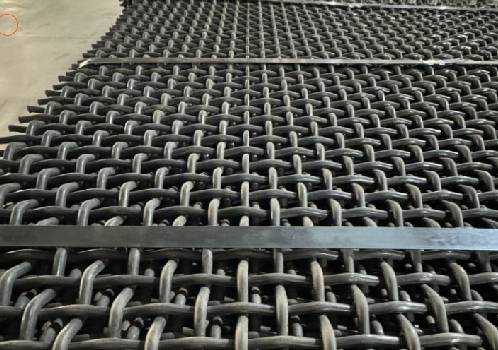
The woven structure must use full pre-crimped interlocking wires that eliminate any lateral slippage, ensuring aperture deviation stays below 3% even after 1000+ hours of continuous high-frequency vibration. This prevents the common issue of oversize ore slipping through distorted openings and contaminating fine crushed product, which would force operators to reprocess entire batches of material. For wet ore screening applications, the mesh must also maintain consistent opening dimensions even when exposed to high-pressure water flushing and fluctuating operating temperatures.
Installation and Compatibility Standards
The woven metal screen must be pre-stretched during manufacturing to match the exact tension requirements of standard vibrating screening decks, so on-site teams can install it without extra custom cutting or welding work. The open area ratio should be calibrated to match the ore’s specific hardness and moisture content, balancing high throughput with precise separation accuracy to avoid unnecessary fines loss during the crushing and grading workflow.
If your plant frequently experiences unplanned downtime due to screen breakage or uneven ore classification, and you are looking to replace your screens, please feel free to contact us for purchasing options and free expert advice. We will tailor a solution to your specific operating conditions to help improve overall screening efficiency.
Leave a Message